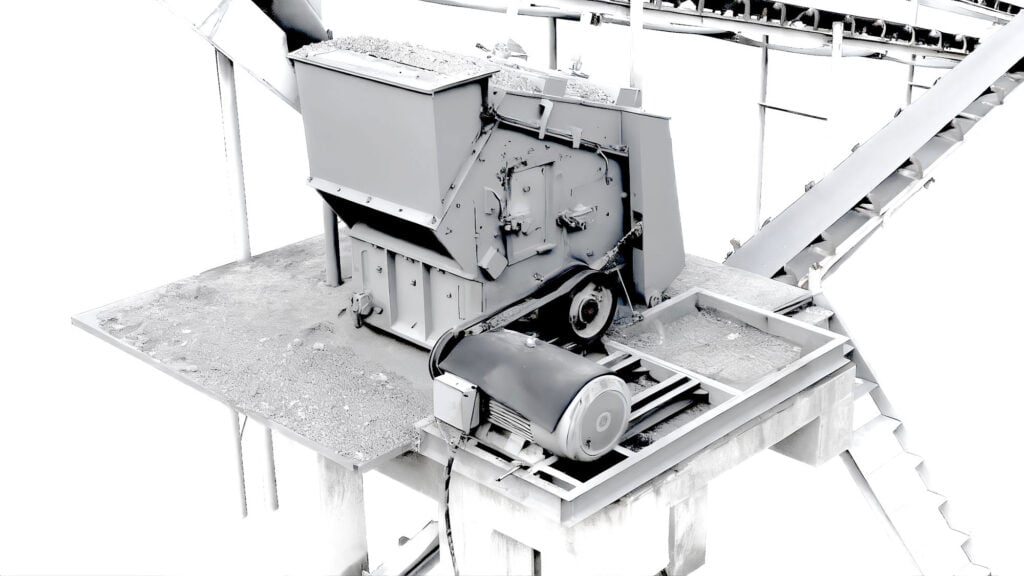
High-Efficiency Secondary Crushing for Cubic Aggregates
Horizontal Shaft Impact Crusher (HSI)
Get maximum performance with ZME Solutions for Impact Crushers. Specially designed to produce cubic aggregates at secondary and tertiary crushing stages with high efficiency.
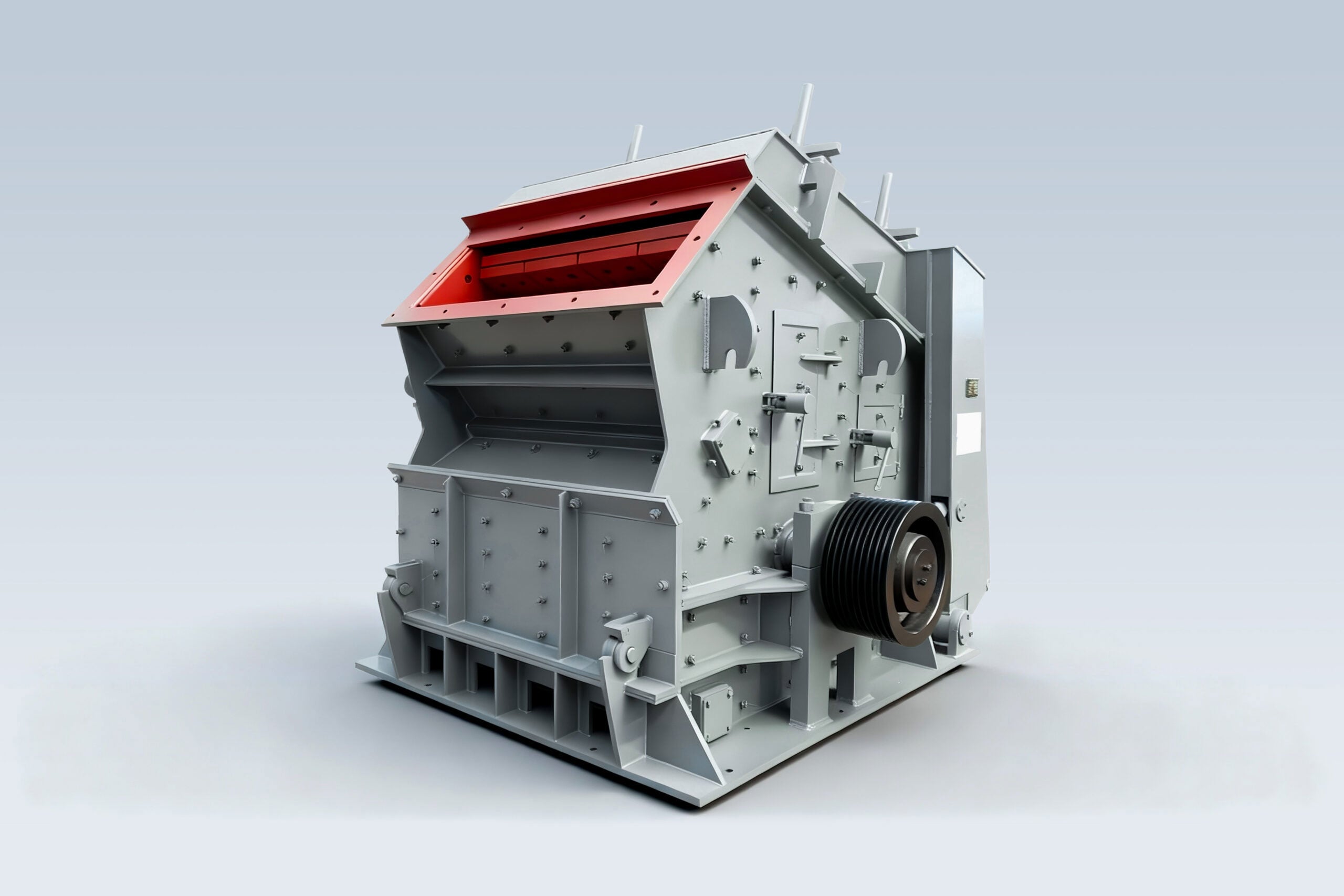
What Is a
Horizontal Shaft Impactor (HSI)?
The Horizontal Shaft Impact (HSI) Crusher—more popularly known as an Impact Crusher—is a crushing machine that relies on the kinetic energy of impact to process medium to low hardness materials. Unlike Jaw Crushers that depend on compression force, HSI crushers produce finer output with a high reduction ratio and exceptionally uniform cubic particle shapes. In aggregate production lines, HSI crushers are frequently paired with Jaw Crushers to serve as a secondary crushing unit.
Particle Shape Advantage: True to its name, the HSI operates by striking material at high speeds using blow bars against impact plates (aprons). This repeated impact process yields cubic-shaped finished products, which are crucial for enhancing aggregate gradation quality and concrete bonding strength in modern construction industries.
How It Works?
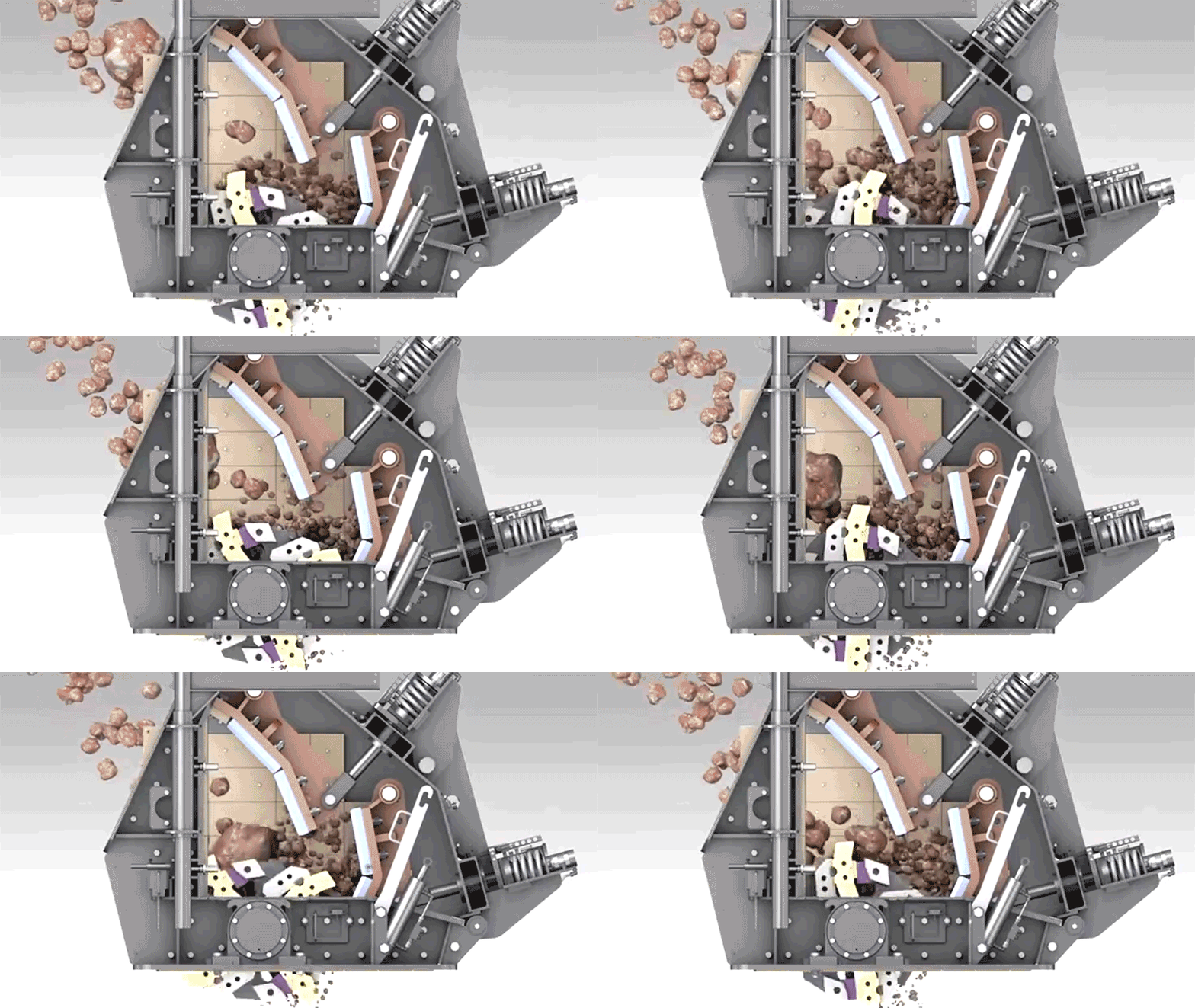
Material enters the feed opening > High-speed rotor strikes the material > Material rebounds and impacts the rotor hammers > Impact against the apron plates crushes it further > Properly sized finished product discharges from the bottom of the machine.
The Horizontal Shaft Impact (HSI) Crusher utilizes high-speed blow bars and impact plates to instantly crush material. As soon as material enters the crushing chamber, it is struck by the blow bars with high kinetic energy and thrown against the impact plates for secondary crushing. This process repeats continuously until the material is reduced to precise particle sizes.
ZME HSI units are equipped with impact plate position adjustment devices and rotor speed control to accurately regulate output particle size. To guarantee stability at mining sites, these machines also feature an overload protection system and automatic safety devices to ensure operational security during heavy workload conditions.
In the HSI unit, material is processed by a high-speed rotor and gradually transitions from large to small sizes through the first, second, and third impact chambers. After undergoing a series of repeated impacts and rebounds inside the crushing chamber, the material achieves the desired gradation size and discharges smoothly through the outlet chute.
Application
Horizontal Shaft Impact Crushing Machine
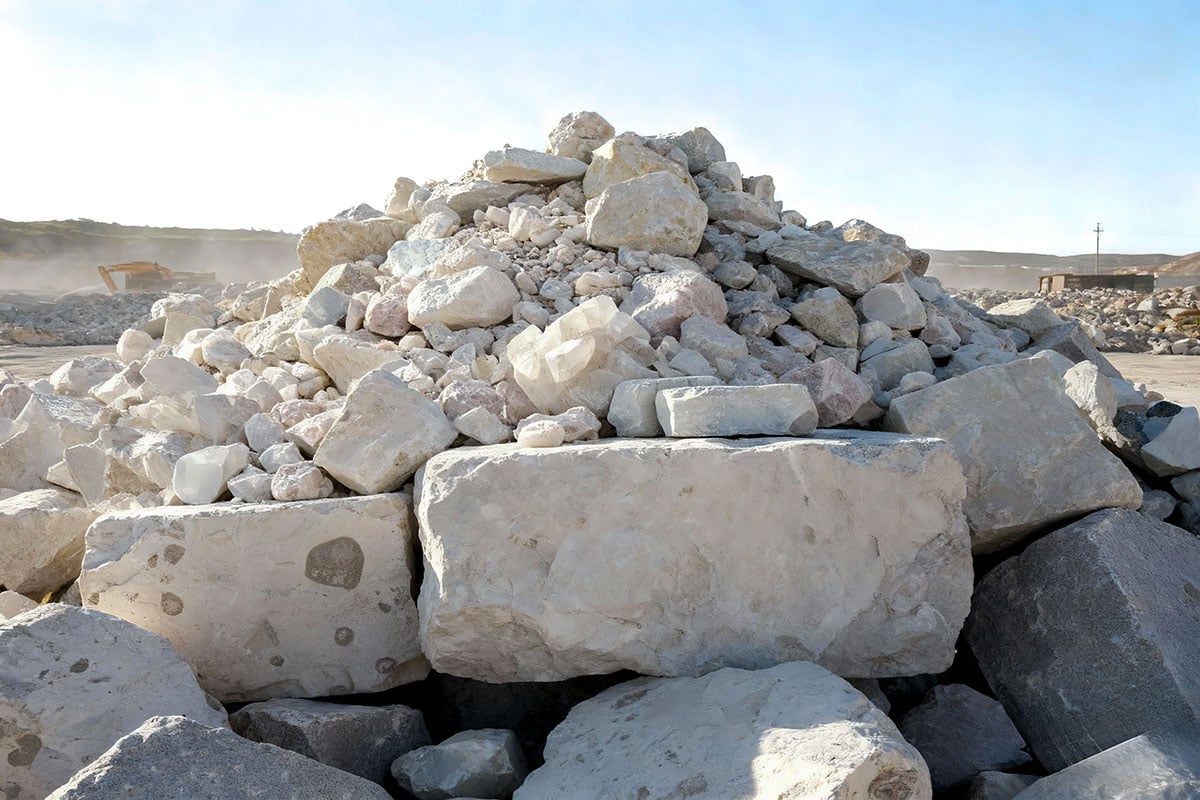
Horizontal Shaft Impact (HSI) Crushers are widely used for medium (secondary) to fine (tertiary) crushing processes. These machines are designed to handle feed sizes ranging from 100 to 600 mm. Although capable of processing rocks with high compressive strength, their optimal efficiency is achieved with materials such as limestone, dolomite, calcite, barite, recycled concrete, and construction waste. For highly abrasive rocks like granite, ZME HSI crushers ensure consistently precise finished products.
Advantages in Aggregate and Manufactured Sand Production: In the aggregate and manufactured sand processing industries, ZME HSI crushers offer a high reduction ratio with adjustable product sizes. The final output features a perfect cubic shape, which is a key requirement for high-quality concrete. Featuring a compact structural design, low energy consumption, and stable production capacity, this machine significantly boosts your plant’s operational efficiency.
Economical Solution for Various Industrial Scales: This machine is highly flexible for both coarse and fine crushing applications, especially when product shape quality is a top priority. Delivering reliable performance, the HSI Impact Crusher features a standard production capacity ranging from 120 to 650 t/h. This makes it the most economical solution for industrial operators requiring high output with controlled maintenance costs.
Top 3 Important Factors for
ZME Horizontal Shaft Impact Crushing Machine
The ZME Horizontal Shaft Impact (HSI) Crusher offers efficient crushing performance with high-quality cubic finished products, flexible output size adjustment, and low operational costs thanks to wear-resistant component designs and lower energy consumption.
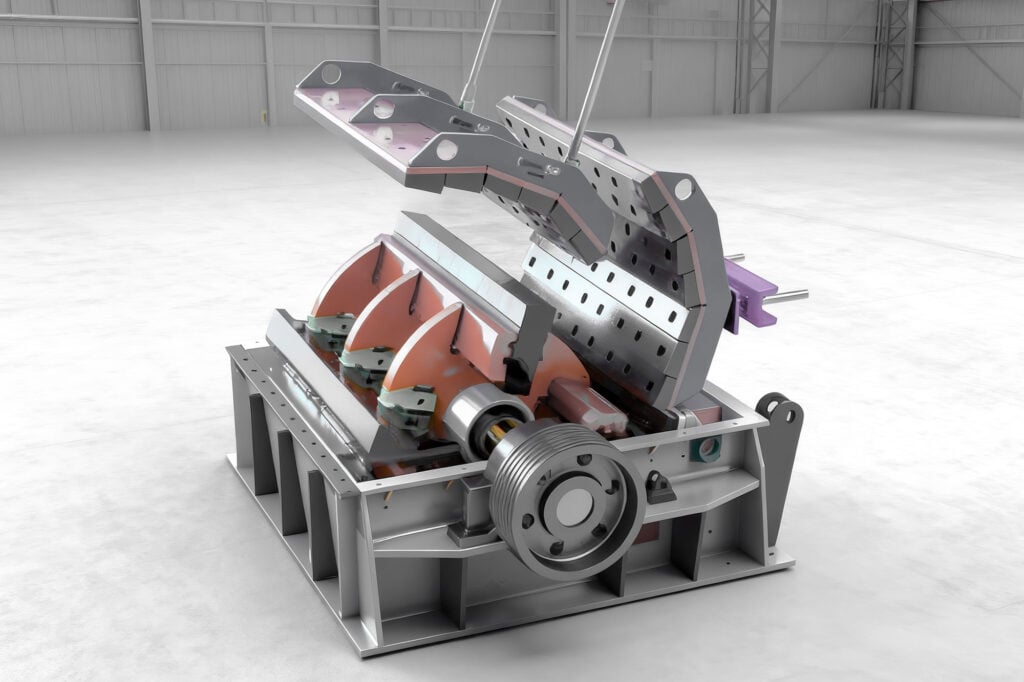
Efficient Crushing and Superior Product Shape
The ZME Horizontal Shaft Impact (HSI) Crusher features a large involute crushing chamber designed using advanced software simulation technology and proven reliable in field applications. Material undergoes multiple impacts within this chamber, yielding superior cubic particle shapes that are ideal for premium concrete aggregate production.
A wide range of discharge opening adjustments allows for precise product size tuning according to user requirements.
Note: The optimized crushing chamber design boosts efficiency while simultaneously improving the shape and gradation of the final product.
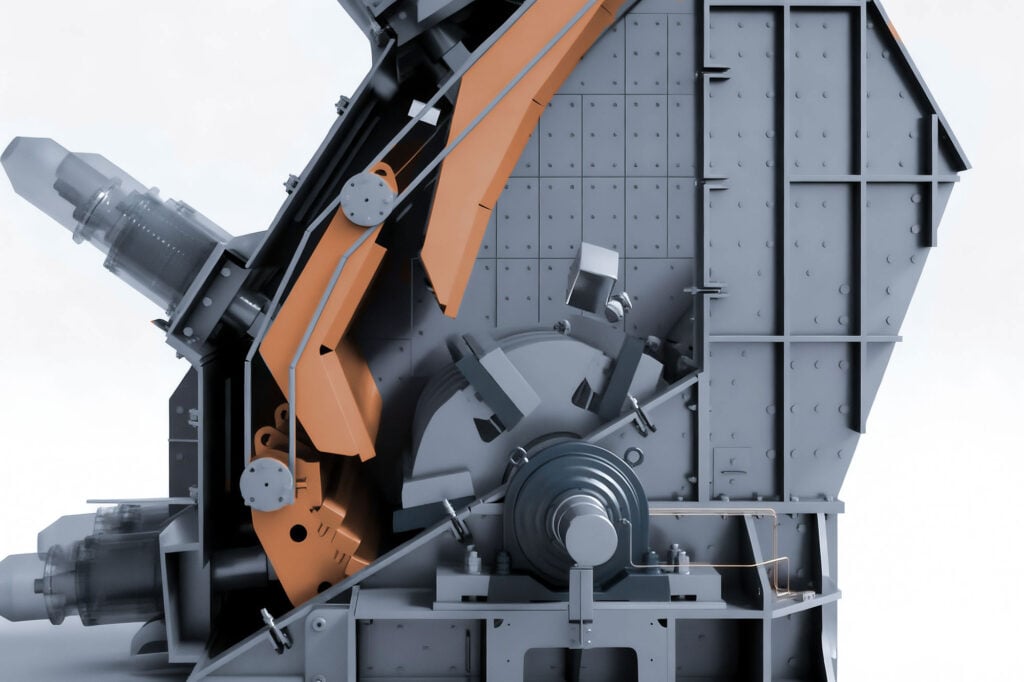
Wear-Resistant Design and Low Maintenance Cost
This machine is equipped with blow bars made of high-chrome cast iron and wear-resistant impact plates, offering excellent abrasion resistance and impact strength. The high-precision, quick-response adjustment system simplifies component replacement and output size adjustment, effectively reducing labor costs and maintenance downtime.
Note: The combination of premium wear-resistant materials and a quick-adjustment design helps significantly reduce operational costs.
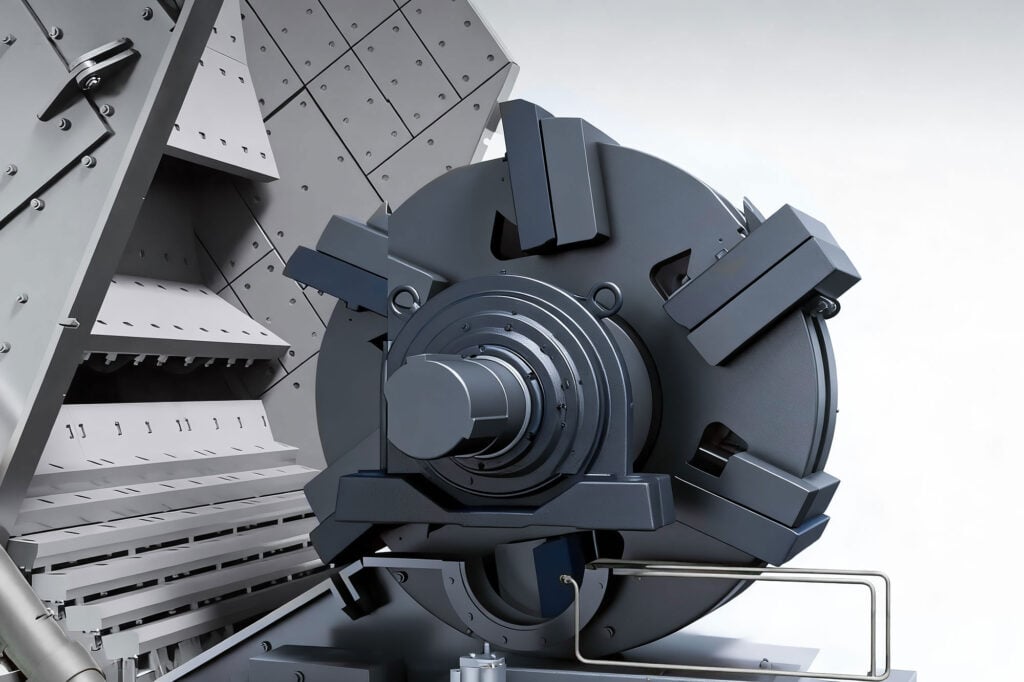
Heavy-Duty Rotor System and Stable Operation
The rotor adopts a high-precision, heavy-duty design with high inertia, paired with premium-grade bearings to ensure load capacity and operational stability. Materials are optimally accelerated prior to crushing, resulting in a higher reduction ratio and more consistent machine performance.
Note: The high-inertia rotor design enhances crushing force and long-term operational reliability.
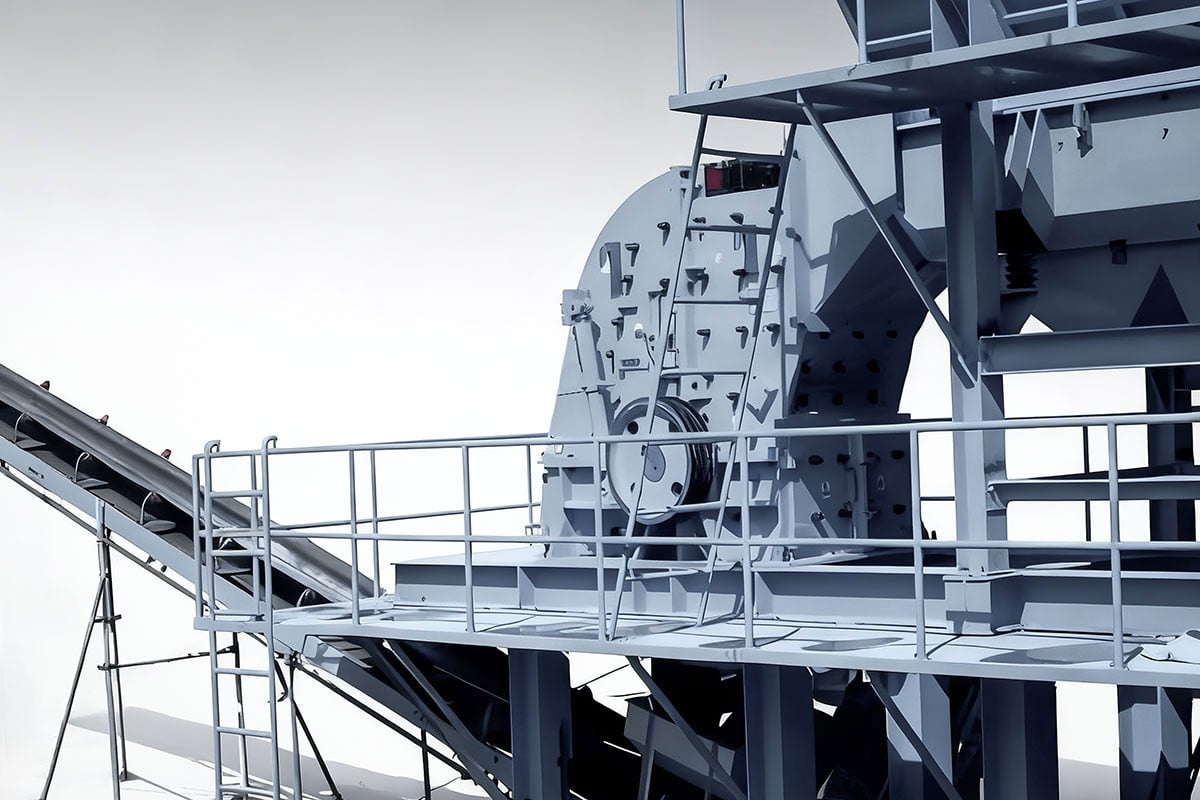
Advantages of
ZME Horizontal Shaft Impact Crusher
The ZME Horizontal Shaft Impact (HSI) Crusher is designed with a heavy-duty, high-inertia rotor and highly wear- and impact-resistant “boat-shape” blow bars, guaranteeing a perfectly cubic particle product. The machine offers easy maintenance via strategically located inspection doors and convenient mechanical blow-bar installation. With wear part commonality exceeding 80%, spare parts inventory costs are optimized. The synchronized combination of crushing chamber design, rotor speed, and motor power delivers massive production capacity with an exceptional reduction ratio. Furthermore, a hydraulic gap adjustment system and a comprehensive safety system are integrated to elevate both efficiency and overall operational safety.
Key Features & Technical Innovations:
Maximum Impact Performance: The new-generation high-inertia rotor combined with high impact force increases the reduction ratio and maximizes single-pass product yield.
Consistent Product Gradation: Specially engineered blow bar profiles maintain a stable surface geometry throughout their service life, ensuring consistent product gradation quality until the end of their wear limit.
Fast & Innovative Maintenance: An innovative locking system streamlines and accelerates blow bar replacement and maintenance, minimizing machinery downtime.
Spare Parts Efficiency: High component commonality of over 80% with only 2–3 main spare part types significantly lowers inventory holding costs.
Robust Structure & Large Capacity: The heavy-duty rotor and high-grade welded frame withstand extreme shock loads, boosting both production capacity and reduction ratio.
Next-Gen Wear-Resistant Materials: Utilizing high-chrome alloy on boat-shaped blow bars extends replacement intervals and ensures continuous output size stability.
Hydraulic Control & High Flexibility: Features a hydraulic system for curtain gap adjustment, automatic safety devices, and an optional third impact curtain to speed up setups and produce premium aggregate cubic particles.
Technical parameters
Parameter Teknis Horizontal Shaft Impact Crusher (HSI)
| Model | Specification (mm×mm) | Feed Opening Size (mm×mm) | Max. Feed Size (mm) | Capacity (t/jam) | Motor Power (kW) | Weight (excl. motor) (t) | Machine Dimensions (mm) |
| PF-0807 | 850×700 | 730×400 | 120 | 15–30 | 45 | 8 | 2210×1490×2670 |
| PF-1007 | 1000×700 | 730×400 | 300 | 25–45 | (55) 30–55 | 9.5 | 2400×1558×2660 |
| PF-1010 | 1000×1050 | 1080×400 | 350 | 50–80 | (75) 55–90 | 12 | 2440×2250×2620 |
| PF-1210 | 1250×1050 | 1080×400 | 350 | 80–130 | (110) 110–132 | 14 | 2690×2338×2890 |
| PF-1310 | 1300×1050 | 1170×490 | 350 | 80–140 | (132) 132–160 | 18 | 2690×2668×2890 |
| PF-1214 | 1250×1400 | 1430×400 | 350 | 70–100 | (132) 132–160 | 18 | 2690×2688×2890 |
| PF-1214 III | 1250×1400 | 1430×630 | 350 | 80–160 | (132) 132–160 | 18.3 | 2690×2688×2890 |
| PF-1315 III | 1300×1500 | 1640×858 | 500 | 150–220 | 200 | 19.5 | 3096×3273×2667 |
| PF-1320 III | 1300×2000 | 2030×860 | 500 | 200–220 | 250 | 29 | 3096×3470×2690 |
| PF-1515 III | 1500×1500 | 1530×850 | 500 | 220–280 | 315 | 28.3 | 3553×2835×3277 |
| PF-1520 III | 1500×2000 | 2040×830 | 500 | 300–550 | 440 | 35 | 3553×3055×3300 |
FAQ
What is the main difference between a Horizontal Shaft Impact (HSI) crusher and a jaw crusher?
Simply put, the difference lies in the “Crushing Method.” A Jaw Crusher works like human teeth that press (compress) material until it breaks. Meanwhile, an HSI acts like a giant hammer that strikes (impacts) material at high speeds.
This difference in “playstyle” gives the HSI two killer advantages:
- A Far More “Aggressive” Reduction Ratio
Imagine this: HSI can achieve a reduction ratio of over 50, whereas Jaw Crusher typically maxes out around 20. What does that mean? Under certain conditions, you can skip crushing stages—going from large boulders straight to final products in a single stage. Pretty practical, right? - A Much More “Appealing” Final Product (Cubical Shape)
If your project demands high-grade aggregate, HSI is the clear champ. Flaky or elongated particles in HSI output remain below 10%, which is significantly better than Jaw Crusher output, which usually sits above 15%. HSI output yields a more cubical (box-like) shape—exactly what high-end concrete contractors are looking for!
What are the main components of the HSI Machine?
Building a robust HSI Crusher requires precision-engineered components. At ZME, we break down the main HSI components into vital sections to ensure stable performance and hassle-free maintenance:
- Core Drive (Rotor System)
- Main Shaft: The central rotational axis delivering machine power.
- Rotor Body: Heavy-duty design engineered for maximum inertia.
- Blow Bar: The primary weapon for crushing materials.
- Crushing & Protection System:
- Front & Rear Impact Frames: The chamber where materials are repeatedly impacted.
- Impact Plate & Liner Plate: Steel shields protecting the machine frame from wear and tear.
- Square Steel & Impact Plate Bolts: Heavy-duty fasteners securing components firmly against vibration.
- Adjustment & Safety System:
- Spring & Safety Guards: Protects the machine against shock loads and uncrushable tramp objects.
- Flip Cover / Opening Device: Allows technicians convenient inspection access to internal parts.
- Locking Block & Wedge Block: Secures blow bars firmly in position during high-speed rotation.
What is the function of the impact plate in an HSI Crusher?
Imagine the Impact Plate as the “rebound wall” inside a crushing arena. Its role is crucial: it absorbs and withstands the violent impacts of material “shot” toward it by the high-speed blow bars.
Here is how the action unfolds: Material is first struck forcefully by the fast-spinning blow bar, hurled against the impact plate, and bounced back toward the rotor to be crushed again. This repeated “bounce-and-collide” process ensures rocks break down progressively until reaching your desired target size.
In terms of construction, ZME impact plates are typically crafted from high-strength welded steel and lined with premium wear-resistant liners. Depending on your operational needs, the design can be tailored—such as utilizing impact rollers or grate plates—to maintain optimal output and high efficiency.
What are the key characteristics of the rotor in a Horizontal Shaft Impact Crusher?
You could say the rotor is the “heart” of the entire crushing process. This is what makes ZME HSI crushers so powerful. Here are its main characteristics:
Maximum Inertia (Crushing Power): The rotor is engineered with high mass and a massive moment of inertia. Imagine a giant flywheel spinning—once in motion, it stores enormous kinetic energy, delivering a powerful crushing blow even to the hardest materials.
Design Flexibility: For lighter-duty applications or smaller machine sizes, we offer fabricated welded steel plate rotor options. This provides a smart solution to balance structural strength with capital expenditure efficiency.
Robust and Durable: Our HSI rotors are typically constructed from solid cast steel. This heavy-duty design not only ensures a long service life, but also makes blow bar installation vastly more practical and secure.
What are the advantages of blow bars in an HSI Crusher?
As the “spearhead” of the crushing process, the Blow Bar is the most vital component in an HSI crusher. Its advantages depend heavily on its material and design, as this is the exact part colliding directly with hard rock every second.
Here are the main advantages of ZME blow bars:
Versatile & Efficient Shape Designs: Blow bar geometry significantly affects production output. We offer various profiles including T-shape, S-shape, I-shape, axe-shape, and grooved types. However, for maximum efficiency and stable operation, the straight bar design remains the top choice for mining industry operators.
Secure Locking System: Blow bar performance is greatly influenced by its locking mechanism. ZME designs ensure the blow bar is firmly locked onto the rotor while remaining easy to install and replace, saving you valuable time during wear part maintenance.
Super Wear-Resistant Materials: Our blow bars are typically crafted from high-chrome cast iron, high-manganese steel, or specialized alloy steel. These materials are selected for their extreme abrasion resistance and high impact toughness, preventing premature breakage even under continuous heavy impact.
What are the most critical wear parts in an HSI Crusher?
In mining operations, knowing component wear life is key to avoiding unexpected production downtime. The components experiencing the highest material contact—requiring extra attention—are the Blow Bar, Impact Plate, and Side Liner.
Because rock conditions vary by site, wear life differs significantly. However, general wear life estimates are as follows:
- Blow Bar: The most stressed component due to direct rock impact. Average service life is around 1 month, though extremely hard/abrasive rock can wear it out in as little as 1 week.
- Impact Plate: Offers longer durability, typically requiring replacement every 2 months.
- Side Liner: This frame-protection liner generally lasts up to 3 months.
ZME Spare Parts Inventory Tip: To prevent warehouse overstock while ensuring operational safety, we recommend a stocking ratio of 3 : 2 : 1. This means for every 3 sets of blow bars, you only need to stock 2 sets of impact plates and 1 set of side liners.
How do the long-term operational costs compare between an HSI and a Cone Crusher?
That is a smart question. Although a Cone Crusher typically requires a higher initial purchase price (CAPEX) compared to an HSI, the cost dynamics shift significantly when evaluating long-term operational expenses (OPEX).
Here is the comparison:
- Wear Parts Efficiency: Cone Crushers are engineered for hard, abrasive rocks. Their wear parts generally boast a much longer service life and do not require replacement as frequently as an HSI, keeping continuous spare parts procurement costs to a minimum.
- Downtime Minimization: Because its components last longer, a Cone Crusher requires less maintenance frequency. This translates to longer operating hours in the field with fewer interruptions for part replacements.
- Economic Verdict: From a long-term operational perspective, Cone Crushers often offer superior overall economy compared to HSIs, especially when processing hard materials. However, an HSI remains the top choice if your priorities are excellent cubical particle shape and lower initial capital investment.
What are the main differences between an HSI Crusher and a VSI Crusher for sand making?
Although both utilize impact force, HSIs and VSIs have distinctly different specializations. Think of the HSI as a “Crushed Stone Maker” and the VSI as a “Sand Maker.“
Here are the 6 fundamental differences you need to know:
- Feed & Product Size (Aggregate vs. Sand):
- HSI: Handles large feed sizes up to ≤800 mm, producing predominantly coarse aggregates.
- VSI: Limits maximum feed to ≤190 mm, but excels at producing fine 0–10 mm sand. Highly specialized for sand making.
- Internal Structure (Grate Bar):
- VSI: Equipped with grate bars to screen and precisely control finished sand sizing.
- HSI: Does not use grate bars, as its primary focus is high-volume primary/secondary crushing.
- Hammer Design (Blow Bars vs. Small Hammers):
- HSI: Employs 4–8 heavy blow bars suited for striking large boulders.
- VSI: Utilizes 16–24 smaller, fast-acting hammers to generate fine, uniform sand particles.
- Wear Parts:
- VSI: Features additional wear items such as grate bars alongside hammers and liners.
- HSI: Wear maintenance centers around blow bars and impact plates.
- Material Suitability (Soft vs. Hard):
- HSI: Optimal for materials with compressive strength <350 MPa (e.g., limestone). Less suited for extremely hard rocks like basalt or iron ore.
- VSI: Tougher and more adaptable for hard, brittle materials (e.g., cement clinker, river gravel) during fine crushing.
- Primary Application:
- VSI: The absolute “King” of manufactured sand production lines.
- HSI: The “Commander” of aggregate production lines. Forcing an HSI into sand production leads to excessive fine dust generation.